Do I Still Need SEO Now That People Use ChatGPT to Search?
If you're spending money on SEO, there's a reasonable question to ask right now: what happens to that investment if your customers are increasingly using ChatGPT to find information?


Key Takeaways
- SEO isn’t dead. Search is expanding across Google, AI Overviews, ChatGPT, Gemini and other AI platforms.
- Search journeys are becoming fragmented. Customers may discover, compare and evaluate your brand across multiple search experiences before visiting your website.
- AI search changes what visibility means. Rankings and clicks still matter, but being cited, mentioned or used as a source in AI answers matters too.
- GEO and AEO build on SEO. They aren't replacements for SEO. Strong technical foundations, useful content, authority and clear structure still matter.
- Generic content won't cut it. Original research, first-hand expertise, credible sources and genuinely useful answers give your content a better chance of being surfaced.
- The winning strategy is broader SEO. Keep your SEO fundamentals strong while building visibility across both traditional search and AI-powered discovery.
Do I Still Need SEO Now That People Use ChatGPT to Search?
If you're spending money on SEO, there's a reasonable question to ask right now: what happens to that investment if your customers are increasingly using ChatGPT to find information?
That's where the question - do I still need SEO with AI search - comes from. The short answer is yes. The short answer is yes.
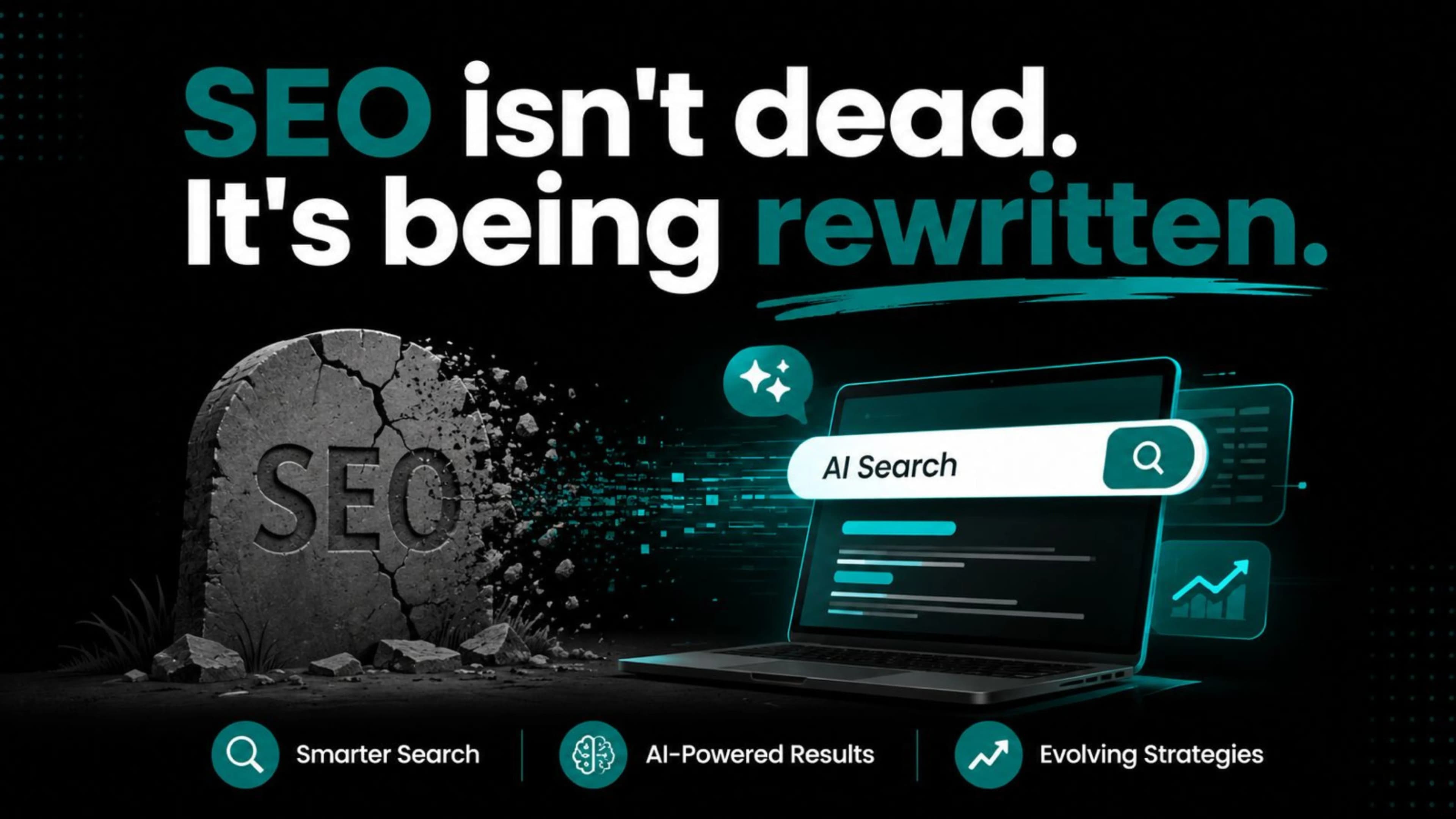
SEO isn't disappearing. Search is expanding & the way people discover, compare & evaluate information is changing with it. Google still matters, but AI Overviews, AI Mode, ChatGPT, Gemini & other AI tools are becoming part of the same discovery journey.
What is changing is where visibility happens. A customer might discover your brand through a Google result, see it referenced in an AI Overview, ask ChatGPT to compare options & only then visit your website.
That means the goal isn't to choose between SEO and AI search. It's to build an organic presence strong enough to support both.
The businesses that adapt early won't abandon SEO. They'll build on the fundamentals that already work and extend them to the new ways people search.
How People Actually Search Now
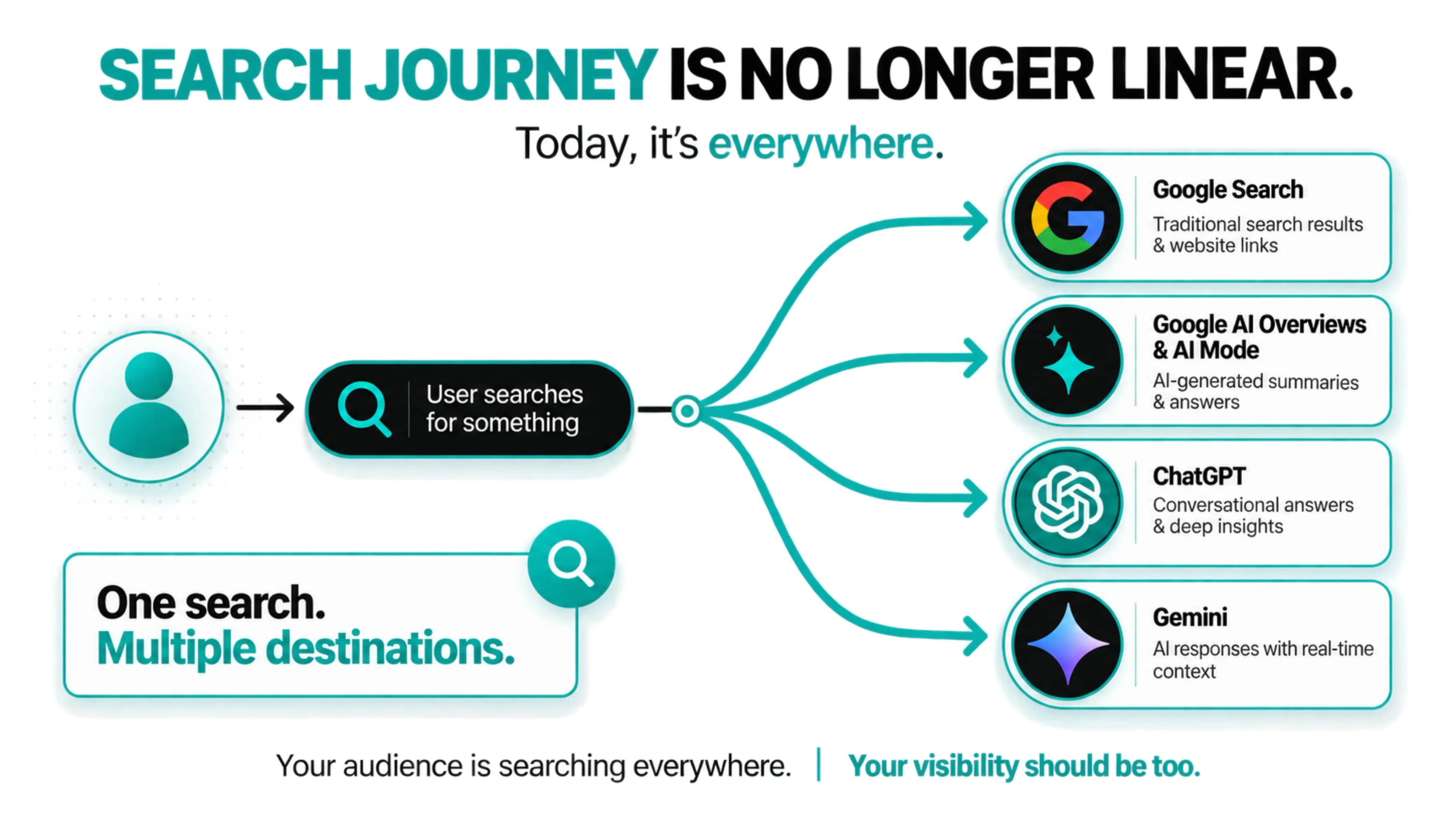
Search isn't moving from Google to ChatGPT in one clean handover. It's becoming more fragmented. This is with people choosing different search experiences depending on the type of information they need.
Pew Research found that 44% of U.S. adults had used ChatGPT in 2026, up from 34% in 2025. That is a meaningful increase. But it doesn't mean Google has suddenly become irrelevant. People are just adding AI tools to the ways they already search, research, compare & make decisions.
Google is part of that shift too. AI Overviews and AI Mode can answer increasingly complex queries directly within Search, changing what users see before they ever visit a website. The traditional search results page is becoming just one part of a much broader discovery experience.
This is why the question “is SEO still relevant with ChatGPT?” shouldn't be answered by comparing one platform against another. The more useful question is how SEO vs AI search changes the way businesses need to think about visibility.
Google still drives discovery. ChatGPT and other AI tools are gaining ground. AI features are also changing Google itself. The important shift is that customers now have more ways to encounter your brand, your content & your competitors before they ever reach your website.
What AI Search Actually Changes for Your Business
The biggest change in SEO in the age of AI isn't simply where people search. It's what happens between a search and a website visit. AI can answer questions, compare options, summarize information & recommend businesses before a customer ever reaches a traditional search result.
For businesses, that means visibility can no longer be measured only by rankings and clicks. Your content may influence a decision even when the user doesn't visit your site immediately - making the quality, authority & usefulness of your online presence more important than ever.
Some Searches End Without a Click
Traditional search often worked like this: someone searched, saw a result, clicked a website & continued from there.
AI search can compress that journey. A user can ask a detailed question and receive a synthesized answer without visiting several websites themselves.
That creates a genuine challenge for publishers and businesses that have relied heavily on organic clicks. Some searches will produce fewer visits simply because the answer is being delivered directly in the search experience.
But fewer clicks do not automatically mean less value from organic visibility.
Your Website Can Become the Source Behind the Answer
AI systems don't simply invent every answer from nowhere. They can retrieve information from websites, cite sources & use online content to build responses. That creates a different kind of visibility, but it doesn't mean is SEO dead is the right question to ask.
Instead of only asking, “Did we rank for this keyword?” businesses increasingly need to ask, “Did our content become one of the sources used to answer this question?”
Being the source behind the answer can put your brand in front of someone even when that person never lands on your homepage. The click may come later, or the exposure may influence a decision long before a customer searches for your brand directly.
Authority Matters More When Answers Are Synthesized
AI search has another effect that is easy to underestimate: it puts more weight on whether your business looks like a credible source.
Clear expertise, original information, strong brand signals, consistent information across the web & content written for real users all become more valuable when an AI system is deciding which sources to use.
That doesn't mean publishing more content for the sake of it. It means making your content easier to understand, easier to verify, and genuinely useful.
Why SEO Still Matters
There was plenty of warning that traditional search behavior would change. In 2024, Gartner predicted that traditional search engine volume would decline 25% by 2026 because of AI chatbots and other virtual agents. That was a forecast, not a measurement of what ultimately happened - so it shouldn't be presented as proof that Google has been replaced. Gartner's 2024 search forecast
The more useful lesson is that search behavior is changing. And SEO still sits underneath much of the work required to be discoverable in that environment.
AI systems need information to retrieve, understand, evaluate & reference. Your website still needs useful content, a logical structure, strong technical foundations, authority, and clear signals about what your business does.
You can't become the source in an AI answer if the underlying information isn't there.
That is why the question isn't whether SEO survives AI search. The better question is whether your SEO strategy is built for the way search now works.
GEO and AEO Are Not Replacements for SEO
You've probably heard two new acronyms being thrown around: GEO and AEO.
Generative Engine Optimization (GEO) generally refers to improving your visibility in generative AI experiences such as ChatGPT and other AI answer engines.
On the other hand, Answer Engine Optimization (AEO) focuses more broadly on making content useful & accessible to systems that provide direct answers rather than simply returning a list of links.
The terminology is new. The underlying work isn't entirely new.
Technical accessibility, useful content, authority, structure, relevance, and strong information architecture have always mattered in SEO. GEO and AEO extend that thinking into newer search experiences.
That's why treating “SEO vs. AI search” as a choice creates the wrong debate.
Modern SEO needs to account for both.
What to Actually Do Now
The shift to AI search doesn't require throwing out your existing SEO strategy. It requires tightening the parts that matter most.
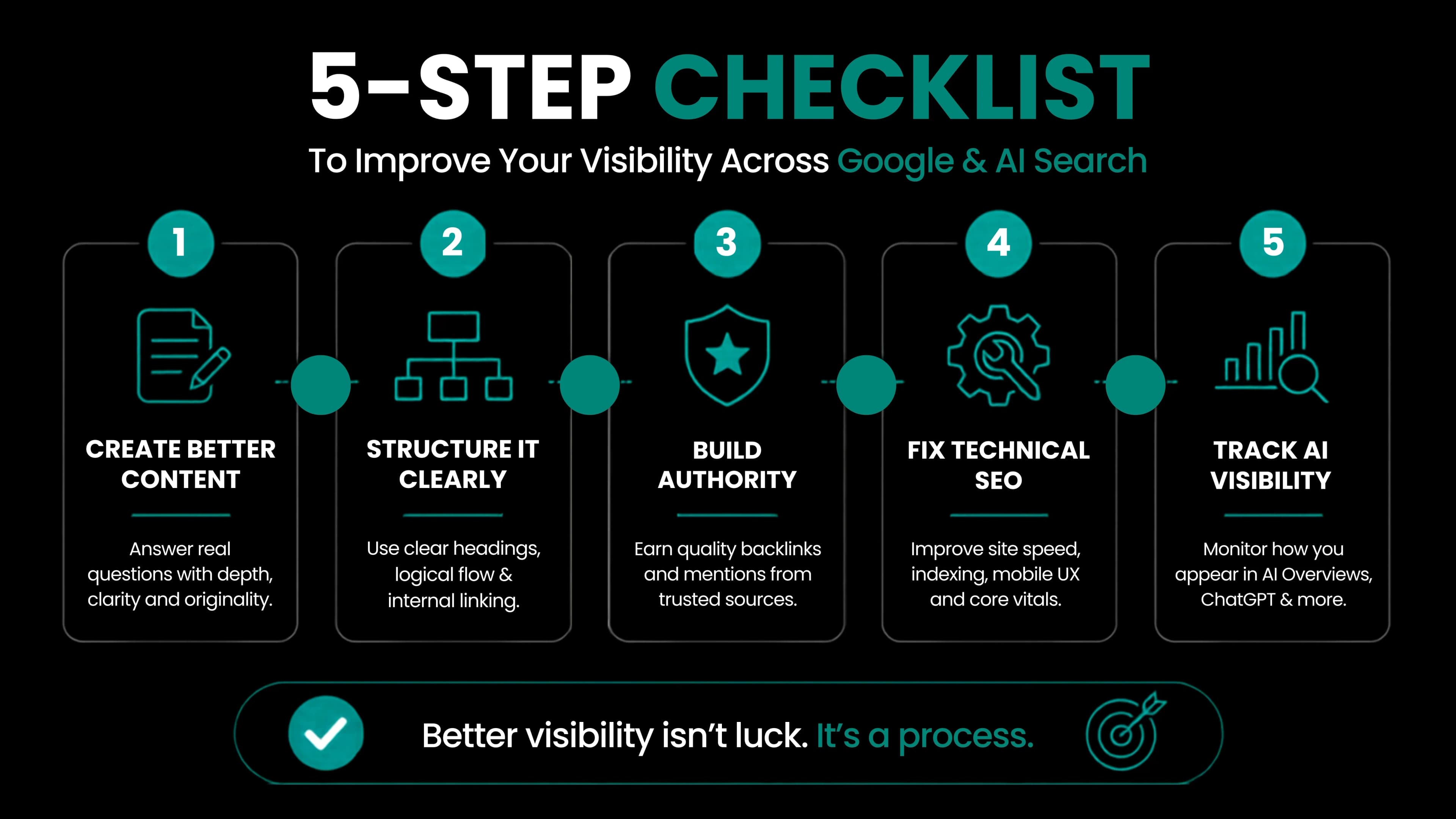
If you're wondering how to rank in AI search - the answer isn't to create content specifically for machines or chase every new AI tactic. Start with the fundamentals - publish information worth referencing, make it easy to understand, build authority around your subject & give search systems enough context to trust your brand.
The goal is to make your website useful across every search experience, not to optimise for one platform at the expense of everything else.
Create Content Worth Citing
AI can summarize generic information very easily. That makes generic content less valuable.
Focus on original research, first-hand expertise, useful examples, strong opinions backed by evidence, and answers that actually resolve the questions your customers have.
If your page says the same thing as the next 50 results - there's little reason for either a search engine or an AI system to prefer it.
Make Your Content Easy to Understand
Clear structure helps both people and machines. As businesses wonder - will ChatGPT replace Google - the more useful question is whether their content can be easily understood and surfaced across both traditional and AI search.
Use descriptive headings, answer important questions directly, organize related information logically, and make key facts easy to identify. FAQs can help when they genuinely address user needs, while appropriate structured data can help search engines understand the page.
The goal isn't to write for a machine. It's to remove unnecessary ambiguity so your content is clear, useful, and easy to interpret wherever people search.
Build Authority Beyond Your Website
Your website isn't the only place where your brand earns credibility.
Industry publications, reputable directories, reviews, expert mentions, partnerships, original research & other credible references - all can contribute to how your business is understood across the wider web.
If your brand exists only on its own website, you're giving search engines and AI systems less external context to work with.
Keep Technical SEO Healthy
Crawlability still matters. So do page speed, indexation, internal linking, clean architecture, mobile usability, and a technically sound website.
There is no special AI shortcut around poor technical foundations.
If search engines and other systems struggle to access or understand your website, adding more content won't solve the underlying problem.
Measure Visibility Beyond Rankings
Rankings remain useful. They just aren't the entire picture anymore.
Look at whether your brand appears in AI Overviews, whether your pages are being cited in AI-generated answers, which topics produce AI visibility, and whether that visibility leads to branded searches, qualified traffic, or conversions.
The measurement layer needs to evolve along with the search experience.
The Biggest SEO Myths About AI Search
AI search has sparked plenty of predictions about the future of SEO. Some are useful, but others make the shift sound far more dramatic than it actually is.
If you're still asking, “Do I still need SEO with AI search?”, the answer comes down to understanding what has actually changed. Search behaviour is evolving, but businesses still need to be found, understood, trusted, and considered before someone becomes a customer.
“SEO Is Dead”
SEO is only dead if by SEO you mean writing pages purely to rank for keywords.
The fundamentals haven't disappeared. Businesses still need to be discoverable, relevant, technically accessible, authoritative, and useful. The difference is that discovery now happens across more surfaces.
“Nobody Uses Google Anymore”
People absolutely still use Google.
AI tools are growing quickly, but search behavior isn't an either-or decision. Someone might use Google to compare products, ChatGPT to understand a complicated concept, and Google again when they're ready to find a local provider.
Your customer's journey can involve several search environments.
“AI Search Means Organic Traffic Doesn't Matter”
Some informational searches will generate fewer clicks. That's real.
But businesses still need to be discovered before customers can trust, compare, contact, or buy from them. Organic visibility can create traffic, citations, brand awareness & demand even when the final interaction doesn't happen through a traditional blue-link click.
The objective is not to protect an old version of search. It's to remain visible as search changes.
FAQ: SEO and AI Search
1. Is SEO still worth it in 2026?
Yes. SEO remains valuable because search engines still drive discovery, while AI search increasingly relies on online information and authoritative sources. The strategy needs to expand beyond traditional rankings to include visibility in AI-generated answers.
2. Will ChatGPT replace Google?
It's unlikely to be that simple. ChatGPT & other AI tools are changing how people search, but Google continues to play a major role in discovery and is itself incorporating AI into Search. The more realistic future is multiple search experiences operating alongside one another.
3. How do I get my website mentioned by ChatGPT?
There is no guaranteed method for getting cited by ChatGPT. Your best approach is to build authoritative, useful, clearly structured content, maintain strong technical SEO, establish credible brand signals, and publish information that provides genuine value beyond generic summaries.
4. What is Generative Engine Optimization (GEO)?
GEO is the practice of improving a brand's visibility in generative AI experiences. It focuses on helping AI systems understand, retrieve, and potentially reference your content when generating answers. It should be viewed as an extension of modern SEO rather than a completely separate discipline.
5. Does traditional SEO still help with AI search?
Yes. Technical accessibility, relevant content, clear site structure, authority, internal linking, and other SEO fundamentals remain important. AI search changes the visibility outcome, but it doesn't remove the need for a website that search systems can access and understand.
6. Is SEO still relevant with ChatGPT?
Absolutely. ChatGPT changes how some people discover information, but it doesn't eliminate the underlying need for businesses to be present, credible, and useful on the web. If anything, the expansion of search surfaces makes a strong organic presence more valuable.
SEO Isn't Going Away. The Definition of Visibility Is Getting Bigger.
The biggest mistake would be responding to AI search by abandoning SEO. The smarter move is to expand what SEO is expected to accomplish. Your business should still be visible when someone searches Google, but it should also have a chance of being surfaced when someone asks ChatGPT, Gemini, or another AI system the same question.
That requires the fundamentals: useful content, technical accessibility, authority, strong information architecture, and a brand people can trust. The difference is that those fundamentals now need to work across more discovery environments, from traditional search results to AI-generated answers and recommendations.
So, do I still need SEO with AI search? Yes. You need an SEO strategy that understands where search is going and builds visibility across the places your customers are actually looking.
If you're unsure whether your current strategy is built for both traditional and AI search, LogicFunnel can review your site and identify where you're visible today, where you're losing visibility, and what needs to change.
Table of Contents
- Key Takeaways
- How People Actually Search Now
- What AI Search Actually Changes for Your Business
- Why SEO Still Matters
- GEO and AEO Are Not Replacements for SEO
- What to Actually Do Now
- The Biggest SEO Myths About AI Search
- FAQ: SEO and AI Search
- SEO Isn't Going Away. The Definition of Visibility Is Getting Bigger.
- Common questions
Let's Grow Your Business
- Top 3 competitor keyword rankings mapped against yours
- Keyword gap report — where they rank and you don't
- Backlink authority comparison
- Priority actions — ranked by impact and achievability
Let's Grow Your Business
- Top 3 competitor keyword rankings mapped against yours
- Keyword gap report — where they rank and you don't
- Backlink authority comparison
- Priority actions — ranked by impact and achievability
Let's Grow Your Business
- Top 3 competitor keyword rankings mapped against yours
- Keyword gap report — where they rank and you don't
- Backlink authority comparison
- Priority actions — ranked by impact and achievability
Let's Grow Your Business
- Top 3 competitor keyword rankings mapped against yours
- Keyword gap report — where they rank and you don't
- Backlink authority comparison
- Priority actions — ranked by impact and achievability
Common questions
If something's not covered here, call us or use the audit form — we'll answer directly.
If something's not covered here, call us or use the audit form — we'll answer directly.