
Agency vs Freelancer vs In-House SEO: How to Choose the Right Setup
SEO rarely fails because a business picked the wrong type of team.It usually fails because the setup doesn't match what the business actually needs.


Key Takeaways
- There is no universal winner in the agency vs freelancer vs in-house SEO decision. The right setup depends on your goals, budget, internal capabilities & how much SEO your business needs.
- Choose a freelancer when you have a focused SEO need, a defined scope, or a relatively straightforward website that one specialist can handle.
- Choose an agency when you need multiple SEO capabilities, such as technical SEO, content, digital PR, analytics, and strategy, without building a full internal team.
- Build in-house SEO when organic search is a proven growth channel & SEO needs to work closely with product, engineering, content, and marketing on an ongoing basis.
- Consider a hybrid model when you need internal ownership but only require external specialists for specific skills or periods of higher demand.
Agency vs Freelancer vs In-House SEO: How to Choose the Right Setup
SEO rarely fails because a business picked the "wrong" type of team.
It usually fails because the setup doesn't match what the business actually needs.
A founder hires a freelancer when the job really requires several specialists. A company builds an in-house SEO team before it has enough work to justify one. Another business pays an agency for capabilities it could have handled with a strong internal hire.
I've worked with all three models: running an agency, building in-house teams & working with freelancers. None is automatically better.
The right choice depends on your budget, stage, goals, internal capabilities & how much of SEO the business is prepared to own.
That is the real agency vs freelancer vs in-house SEO decision.
The Criteria That Actually Decide Your SEO Setup
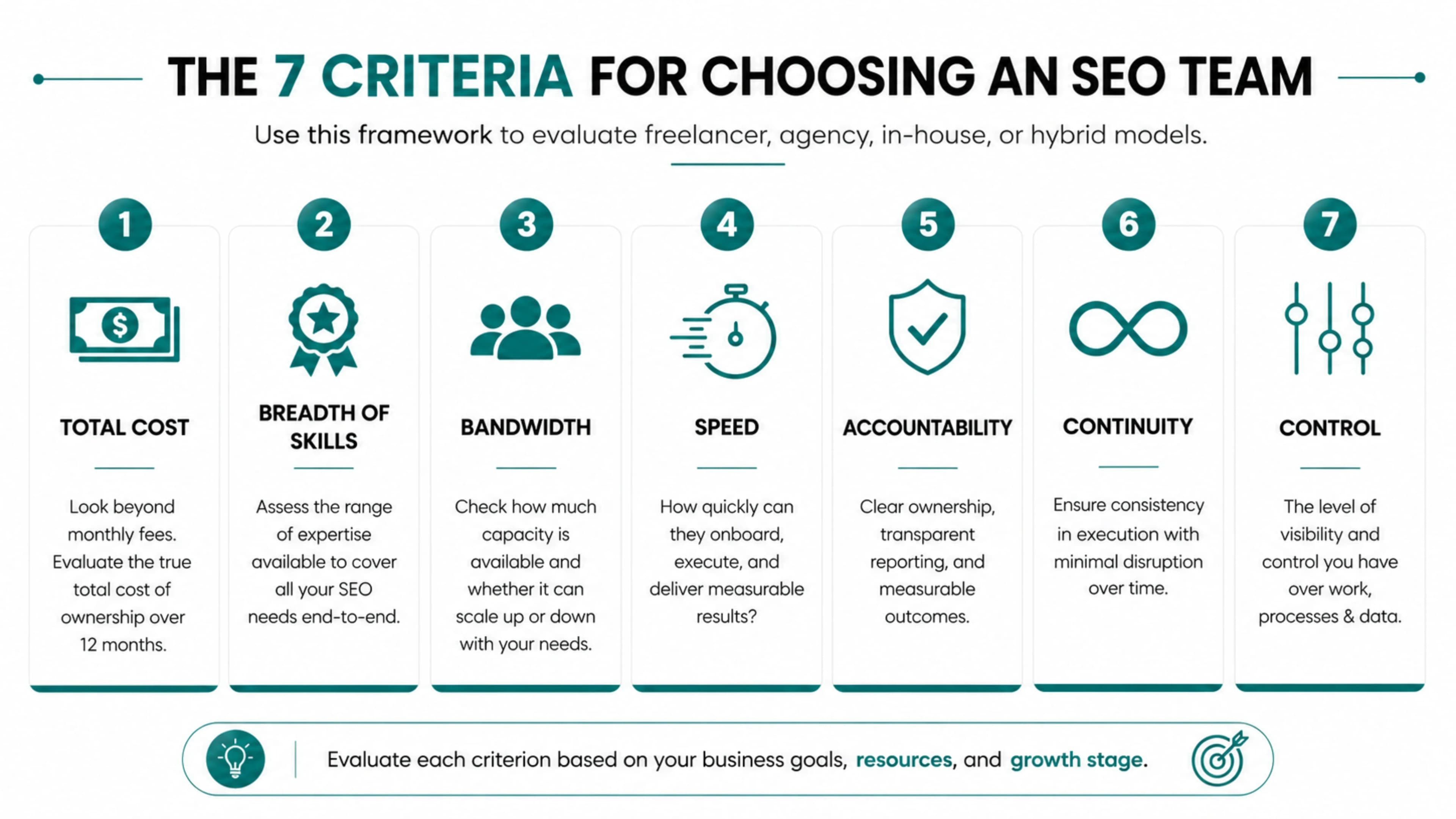
Before deciding who should handle SEO, look beyond the monthly fee. The setup needs to work across seven things that determine whether the relationship will actually produce results.
1. Total cost of ownership
Don't compare an agency retainer with a freelancer's hourly rate and stop there. An in-house hire has salary, benefits, management time, tools, recruiting & onboarding attached to it.
The real question is what it costs to get the level of SEO capability your business needs.
2. Breadth of skills
Modern SEO isn't one job.
Technical SEO, content, digital PR & link acquisition, analytics, CRO, local SEO & strategy - all of them can require different expertise. One person may cover several areas well, but expecting one generalist to be exceptional at everything is usually unrealistic.
3. Bandwidth and scalability
SEO needs can change quickly. You might need a technical audit one month, dozens of content pieces the next & developer support after that. Think about whether your chosen setup can absorb those changes without becoming a bottleneck.
4. Speed to start
An experienced freelancer or agency can usually start faster than an in-house hiring process.
Hiring takes time. Then comes onboarding, learning the business, understanding the site, setting up tools & figuring out internal processes. That ramp-up time has a cost, especially when SEO is already a priority.
5. Accountability
Someone needs to own the number, not just the task list. Who decides what gets prioritized? Who explains why organic traffic dropped? Who reports on what changed and what didn't work? The clearer the accountability, the easier it is to know whether SEO is actually moving forward.
6. Continuity and risk
What happens if the person responsible for SEO leaves?
A freelancer can disappear into a larger client commitment. An employee can resign. An agency can lose the person working on your account.
There is no zero-risk model. The important thing is having documentation, processes, reporting & enough knowledge shared across the team to avoid a single point of failure.
7. Control and cultural fit
In-house teams have the deepest access to the business. Freelancers can offer direct specialist access. Agencies can bring broader expertise without becoming part of your payroll.
The question is how much control you need versus how much capability you want to access.
Freelancer: When One Strong Specialist Is Enough
A freelancer can be an excellent SEO choice when the problem is clearly defined.
If you need a technical audit, content strategy, keyword research, local SEO support, or ongoing optimization for a relatively straightforward website - working directly with an experienced specialist can be efficient. You get fewer layers, faster communication & often a lower cost than a full-service agency.
That direct access is one of the biggest advantages. You're usually speaking to the person doing the work rather than going through account management before reaching the specialist.
Strengths: Direct Access Without the Overhead
Freelancers generally have lower overhead than agencies. This can make them more affordable at large.
They can also be highly specialized. A strong technical SEO freelancer may know more about technical SEO than an entire generalist marketing team.
That can be exactly what you need if there is one clear problem to solve.
Limitations: One Person Has a Ceiling
The limitation is bandwidth.
One freelancer may be excellent at technical SEO but less experienced in content strategy, digital PR, analytics, or conversion optimization. They may also have limited capacity when your workload suddenly increases.
There is also continuity risk. If they become unavailable or take on a larger client, your SEO function can suddenly lose momentum. That doesn't make freelancers unreliable. It simply means you should understand how much of your SEO depends on one person.
Best Fit: Focused Needs and Smaller Teams
I'd consider hiring an SEO freelancer when the business has a defined SEO requirement, a relatively straightforward site, or a tight budget.
It's also a good option when you already have marketing or development capabilities internally and only need specialist SEO support. If one good freelancer can solve the problem well, there is no reason to pay for a larger team.
Agency: When You Need a Complete SEO Function
An agency becomes more useful when SEO is no longer one person's job. In the agency vs freelancer vs in-house SEO decision, this is where an agency can offer a clear advantage.
If you need technical SEO, content, link acquisition, analytics, strategy & ongoing execution working together, an agency can provide that breadth without requiring you to hire each specialist individually.
That is the biggest reason businesses choose agencies.
Strengths: A Bench of Specialists
The value of a good agency isn't simply that it has more people. It's that those people can cover different parts of the problem.
When you're weighing SEO agency vs freelancer cost, the comparison should include more than the monthly fee. You may have a technical SEO specialist looking at crawlability and architecture, a content team building topical coverage, someone handling digital PR or links, and strategists connecting it all to business goals.
Agencies can also bring processes, reporting cadence, established workflows, and access to tools that would otherwise sit on your company's expense sheet. For example, SEO platforms can become meaningful recurring costs. Ahrefs currently lists its Standard plan at $249 per month when paid monthly, with higher tiers for larger teams and more data.
Limitations: More Capability Usually Costs More
The obvious trade-off is cost.
Ahrefs' SEO pricing survey found average monthly fees of $3,209 for agencies compared with $1,348 for freelancers. It also found that 78.2% of SEO providers use monthly retainers for some or all services. These are survey averages, not universal market rates, and scope varies considerably.
There's also a relationship risk. You're one of several clients, so the agency needs strong account management, communication & prioritization.
A large agency isn't automatically better than a small specialist team. In fact, for some businesses, a smaller agency may be a much better fit.
Best Fit: Businesses That Need Breadth
I'd consider an agency when SEO is an important acquisition channel and the business needs several capabilities at once.
It's particularly useful when you want consistent execution without hiring a complete SEO department.
But if your business only needs one specialist for ten hours a month, an agency may be unnecessary overhead.
That's an important distinction, especially when evaluating should I hire an SEO agency or a freelancer.
In-House: When SEO Becomes a Core Capability
In-house SEO makes the most sense when organic search is deeply connected to the business and requires continuous attention. In the in-house SEO vs agency decision, the biggest advantage of an internal team is often context.
An internal SEO professional can work closely with product, engineering, content, sales, analytics & leadership. They don't need to explain the business from scratch every month because they're already inside it.
That context can become a significant advantage, especially when SEO decisions need to move quickly with the rest of the business.
Strengths: Deep Context and Full Control
An in-house SEO can understand the product, customers, brand, competitors & internal constraints at a depth that's difficult for an external partner to replicate. They can also influence decisions before they become SEO problems, which is especially important when you're weighing options like hiring an SEO freelancer versus building internal capability.
A product change, website migration, new category, international expansion, or content initiative can involve SEO from the beginning rather than being handed over after the fact. That level of proximity is particularly valuable when organic search is a core part of the growth model.
Limitations: One Hire Rarely Covers Everything
The biggest mistake is assuming one SEO hire gives you an entire SEO department. SEO covers too many disciplines for one person to be exceptional at everything, so you may still need writers, developers, digital PR support, analysts, designers, and other specialists. That's why knowing how to choose an SEO team starts with understanding the breadth of expertise your business actually needs.
Then there is the actual employment cost. The U.S. Bureau of Labor Statistics reports a median annual wage of $166,790 for marketing managers in May 2025. That's not an SEO-specific salary benchmark, but it illustrates why the cost of an experienced internal marketing hire extends well beyond base salary.
You also have recruiting, benefits, management, tools, training & the risk of losing the person after you've invested in getting them up to speed.
Best Fit: SEO-Mature Businesses
I'd consider bringing SEO in-house when organic search is already proven as a meaningful acquisition channel and the business has enough ongoing work to justify dedicated ownership.
It also makes sense when SEO decisions need to sit close to product, engineering, content, and marketing every day. If you're still trying to figure out whether SEO matters to the business, building an entire internal function is probably premature.
Agency vs. Freelancer vs. In-House SEO: The Side-by-Side View
| Criteria | Freelancer | Agency | In-House |
|---|---|---|---|
| Best for | Focused SEO needs | Complete SEO function | Core, ongoing SEO |
| Typical cost | Lowest | Moderate to high | Highest total commitment |
| Skill breadth | Specialist-led | Broad | Depends on team |
| Bandwidth | Limited | Scalable | Scales with hiring |
| Speed to start | Fast | Fast to moderate | Slowest |
| Accountability | Direct | Structured | Internal |
| Continuity risk | Higher | Lower with strong process | Depends on team size |
| Tools | Usually included | Usually included | Business pays directly |
| Control | High access | Shared | Highest |
| Best advantage | Specialist access | Breadth | Business context |
The table makes the trade-off clearer: there isn't a universal winner in the agency vs freelancer vs in-house SEO decision. A freelancer tends to win on direct access and cost.
An agency brings broader expertise and scalability, while an in-house team offers deeper business context and control.
The right choice depends on which of those advantages matters most to your business right now & how much SEO capability you actually need.
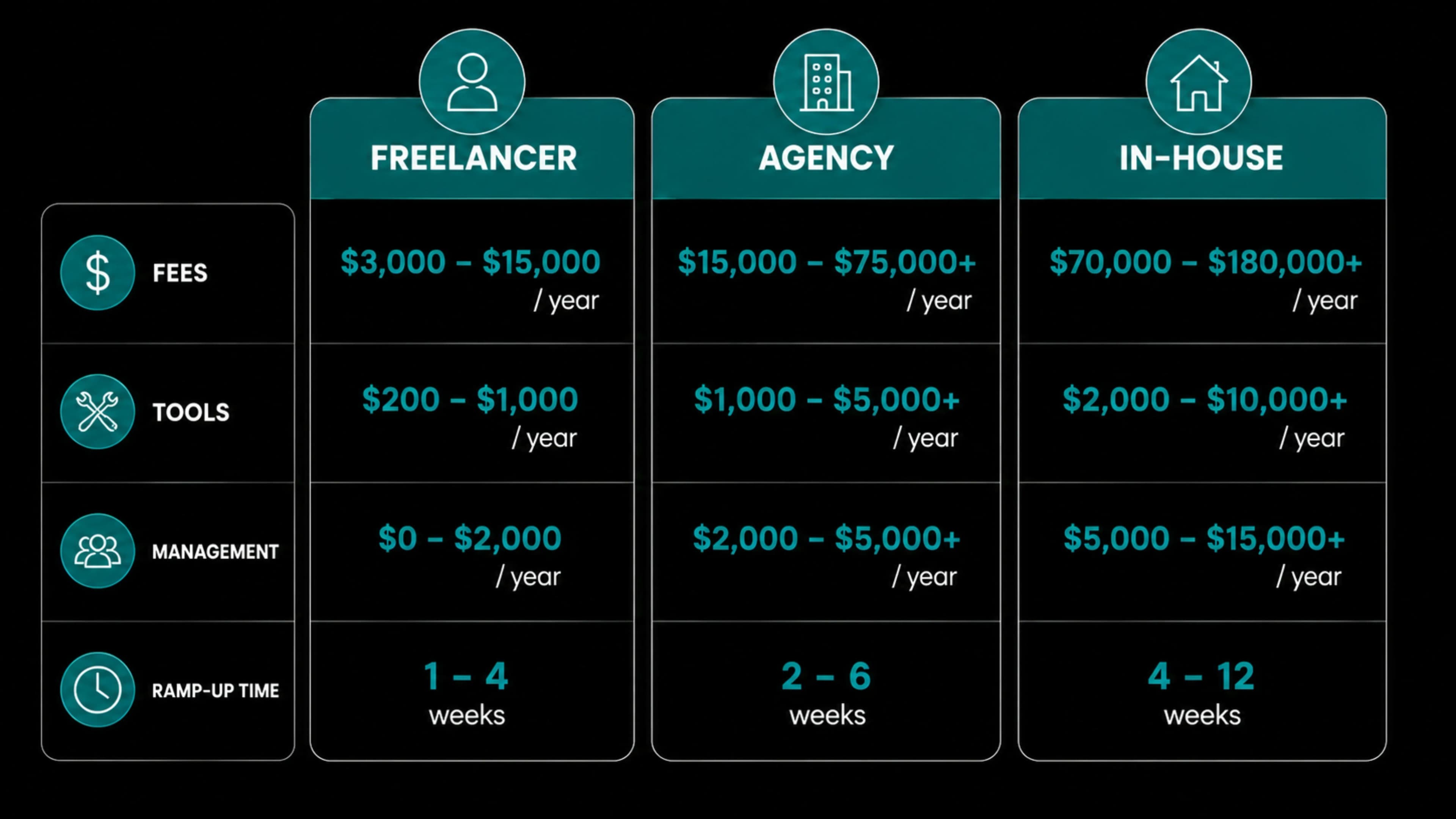
The Cost Reality: What SEO Really Costs Over 12 Months
The SEO agency vs freelancer cost comparison isn't as simple as looking at the monthly fee.
The bigger difference is often what that fee gives you access to. A freelancer may give you direct access to one experienced SEO, while an agency can provide specialists across technical SEO, content, analytics, digital PR, and strategy. An in-house hire gives you the most control and business context, but you also take on the responsibility of building and managing the wider capability around that person.
That makes total cost of ownership more useful than the headline price. Recruiting, benefits, management, software, training, content production, link acquisition, developer support, and ramp-up time can all affect the real investment.
So the better question isn't, "Which option is cheapest?" It's, "What level of SEO capability does this business need, and which model can provide it efficiently?"
The Hybrid Model Is Often the Real Answer
The choice doesn't have to be freelancer versus agency versus in-house.
In many businesses, the strongest setup is a combination.
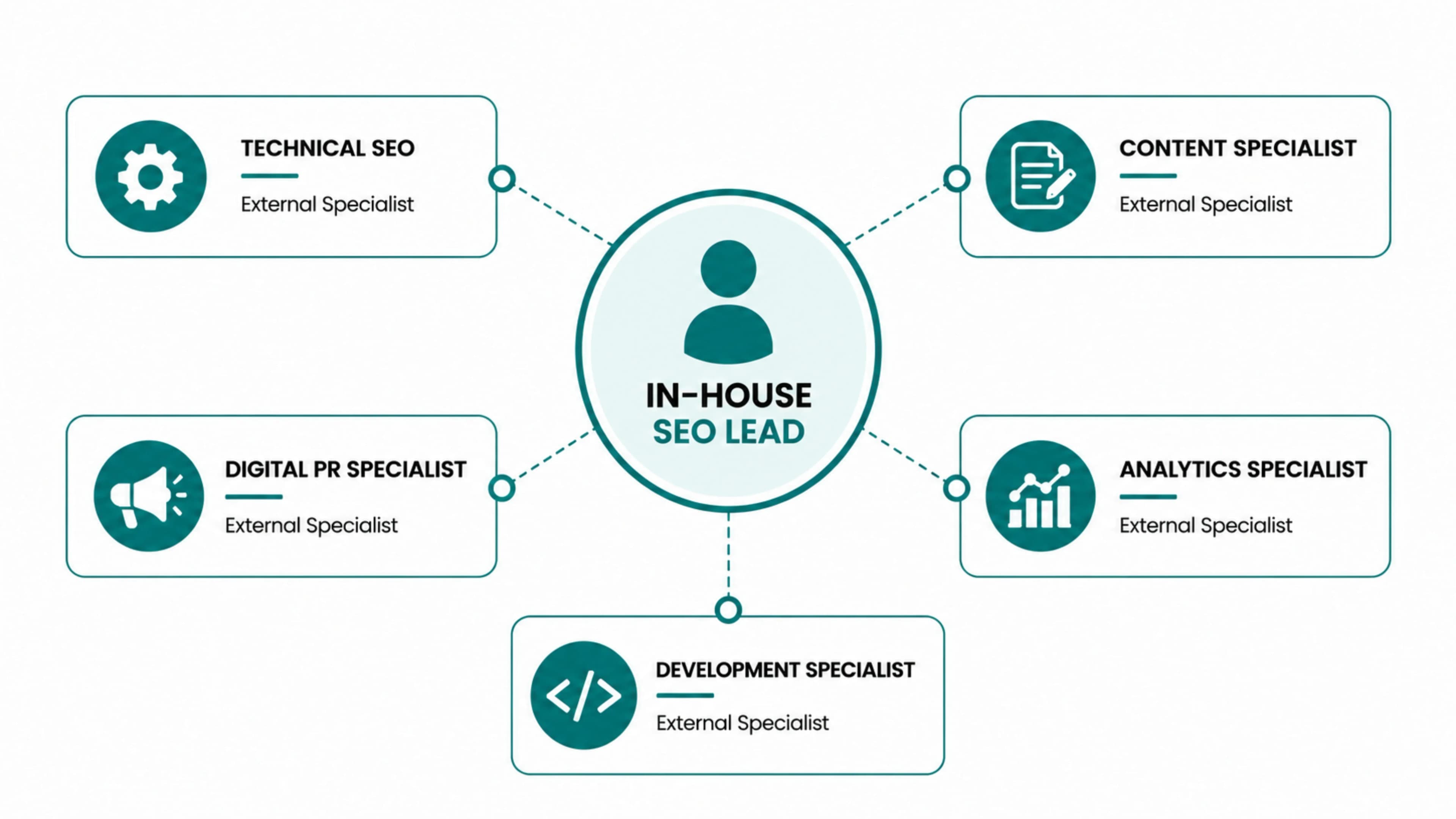
An in-house SEO lead might own strategy, priorities, reporting, and internal alignment while an agency handles technical SEO and content execution. A company might also have an internal marketing manager and bring in a freelancer for a specific technical problem.
Keep Strategy Close. Bring in Specialists Where Needed.
The hybrid model works particularly well when the business has enough SEO activity to justify internal ownership but not enough to hire every specialist. In the outsourcing SEO vs in-house decision, this approach can offer the best of both.
The internal person knows the business and owns the roadmap, while external specialists provide expertise and capacity when needed. It can also reduce continuity risk because strategic knowledge remains inside the company rather than living entirely with an outside provider.
Use the Outside Team for the Gaps
The external partner doesn't need to own everything.
Maybe you need a technical SEO team during a migration. Maybe you need content production for six months. Maybe you need digital PR support that isn't required every day. Instead of building permanent capacity around temporary needs, buy the expertise when the business actually needs it.
A Simple Decision Framework
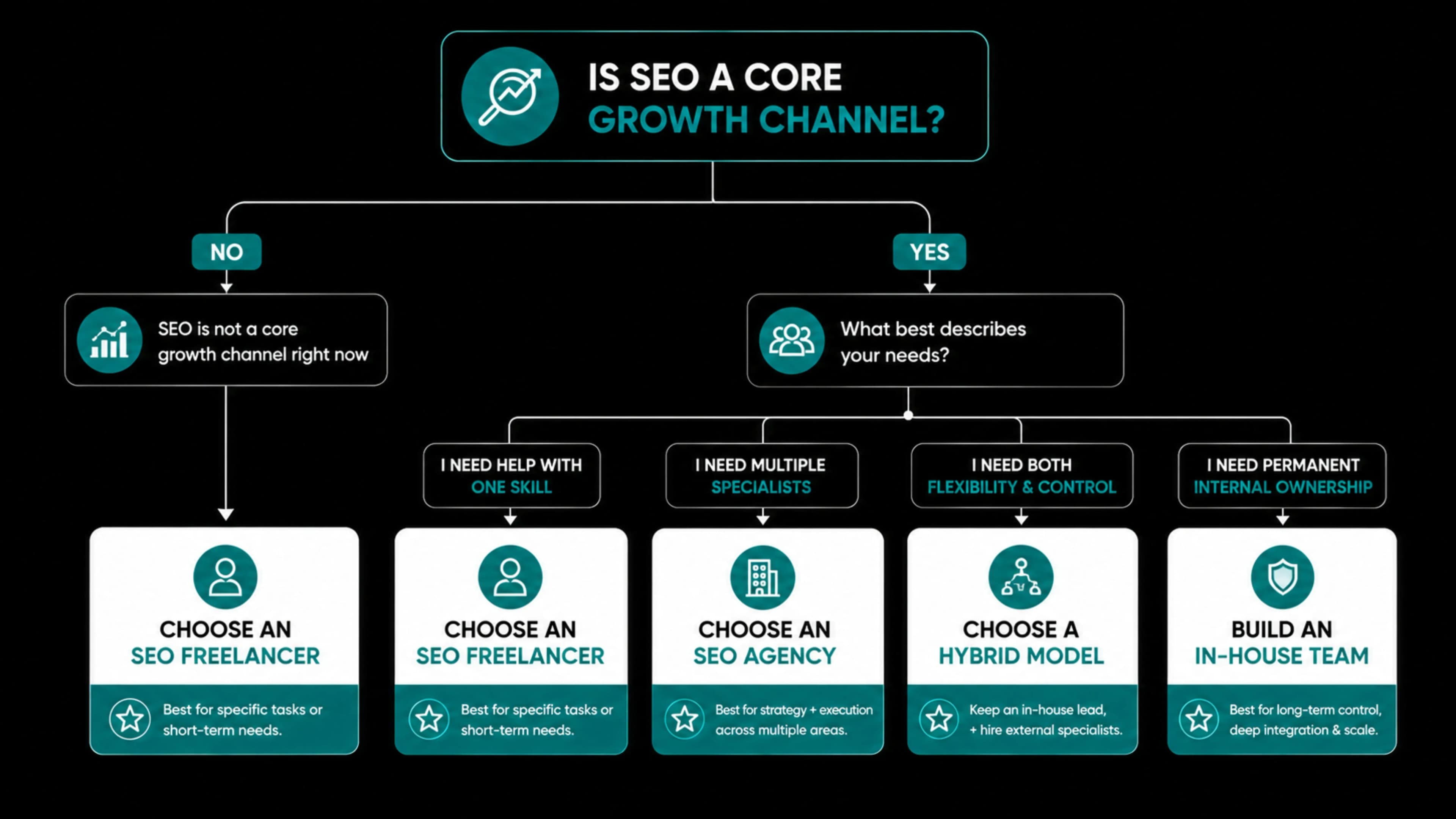
The easiest way to choose is to stop asking which model is best and ask what your business actually needs.
If You Need One Specific SEO Skill
Hire a freelancer.
If the problem is technical SEO, local SEO, a content audit, keyword strategy, or another clearly defined need, a specialist can often solve it faster and more economically than a full agency.
If You Need SEO to Start Moving Quickly
Consider an agency or experienced freelancer.
If there is no internal SEO capability and you need strategy plus execution, an agency gives you broader coverage. If the scope is narrow, a freelancer may be enough.
If SEO Is a Major Growth Channel
Consider an agency, a strong in-house lead, or a hybrid. Once organic search has a direct relationship with revenue, you need more than occasional optimization. You need strategy, execution, reporting, technical access, and someone accountable for results.
If SEO Is Core to the Product
Build in-house capability. When SEO decisions are intertwined with product, engineering, content, merchandising, and business strategy every day, internal ownership becomes increasingly valuable.
You can still use agencies and freelancers for specialist work. In fact, that may be the most efficient model.
If You're Not Sure SEO Will Matter Yet
Don't hire a department.
Start with a focused freelancer or specialist agency engagement. Prove that organic search can contribute meaningfully to the business, learn what capabilities you actually need, and then decide whether bringing SEO in-house makes sense.
Common Mistakes to Avoid
Most bad SEO hiring decisions aren't caused by choosing the wrong model. They're caused by expecting the chosen model to do something it was never designed to do.
Expecting One In-House Hire to Be an Entire SEO Team
A single SEO can be excellent. But technical SEO, content, analytics, digital PR, link acquisition, and strategy can quickly become more work than one person can handle. If you hire one generalist, define the role honestly and give them access to specialists when the work requires deeper expertise.
Choosing the Cheapest Freelancer for a Critical Channel
Price matters. But if organic search is responsible for a meaningful share of revenue, the cheapest provider may be an expensive decision. You're not buying hours. You're buying judgment, execution, and accountability.
Judging an Agency on Month-One Rankings
SEO doesn't work like paid advertising.
A good agency should be able to show what it is fixing, building, testing, and learning before major ranking gains appear. Judge the quality of the strategy and execution, not just whether ten keywords moved in the first 30 days.
Building In-House Before SEO Is Proven
Hiring internally creates a long-term commitment. If the business hasn't established that organic search is an important channel, it can be smarter to work with a freelancer or agency first, learn what the opportunity looks like, and build internal capability when the workload justifies it.
Outsourcing Everything and Owning Nothing
External support shouldn't mean internal accountability disappears. Someone inside the business should understand the SEO strategy, know what the provider is working on, and be able to connect SEO activity to broader business goals.
FAQ: Agency vs. Freelancer vs. In-House SEO
1. Is it better to hire an SEO agency or do SEO in-house?
Neither is automatically better. An agency is usually stronger when you need multiple SEO disciplines without hiring several specialists. In-house works better when SEO is a core, ongoing capability that needs close integration with the rest of the business.
2. Can a single freelancer handle all of my SEO?
Sometimes, especially for smaller websites with straightforward needs. But as SEO becomes more complex, one person may struggle to cover technical SEO, content, analytics, digital PR, link acquisition, and strategy at the same level.
3. When should a business bring SEO in-house?
Consider it when organic search is already a proven acquisition channel, the business has enough ongoing SEO work to justify dedicated ownership, and SEO needs to work closely with product, engineering, content, and marketing.
4. What's the real difference between an SEO agency and a freelancer?
The biggest difference is usually breadth and capacity. A freelancer gives you direct access to one specialist. An agency can provide several specialists, processes, tools, and more execution capacity. That doesn't mean every agency is better; it means the models solve different problems.
5. Is outsourcing SEO better than building an in-house team?
It depends on the business. Outsourcing SEO vs in-house is really a question of capability, control, and economics. Outsourcing is often more efficient when you need specialist expertise without permanent headcount. In-house becomes more attractive when SEO is strategically important enough to justify continuous internal ownership.
The Right SEO Team Is the One You Can Actually Support
There is no universal answer to the agency vs freelancer vs in-house SEO debate.
If a good freelancer can solve the problem, hire one. If your business has enough SEO work to justify permanent ownership, build in-house. If you need several specialists working together without building an entire department, an agency can make sense.
And if none of those options fit perfectly, use a hybrid.
The mistake is choosing a model because it sounds more sophisticated, more affordable, or more scalable on paper. Choose the setup that matches the complexity of your SEO, the stage of your business, and the level of ownership you can realistically provide.
SEO works best when someone is clearly accountable for it, the team has the skills to execute it, and the business gives them enough time and access to do the work properly.
That's a much better hiring framework than simply asking which option costs less.
If you're trying to work out which model makes sense for your business, LogicFunnel can help you assess the scope, capabilities, and level of SEO ownership you actually need before you commit to an agency, freelancer, or internal hire.
Table of Contents
- Key Takeaways
- The Criteria That Actually Decide Your SEO Setup
- Freelancer: When One Strong Specialist Is Enough
- Agency: When You Need a Complete SEO Function
- In-House: When SEO Becomes a Core Capability
- Agency vs. Freelancer vs. In-House SEO: The Side-by-Side View
- The Cost Reality: What SEO Really Costs Over 12 Months
- The Hybrid Model Is Often the Real Answer
- A Simple Decision Framework
- Common Mistakes to Avoid
- FAQ: Agency vs. Freelancer vs. In-House SEO
- The Right SEO Team Is the One You Can Actually Support
- Common questions
Let's Grow Your Business
- Top 3 competitor keyword rankings mapped against yours
- Keyword gap report — where they rank and you don't
- Backlink authority comparison
- Priority actions — ranked by impact and achievability
Let's Grow Your Business
- Top 3 competitor keyword rankings mapped against yours
- Keyword gap report — where they rank and you don't
- Backlink authority comparison
- Priority actions — ranked by impact and achievability
Let's Grow Your Business
- Top 3 competitor keyword rankings mapped against yours
- Keyword gap report — where they rank and you don't
- Backlink authority comparison
- Priority actions — ranked by impact and achievability
Let's Grow Your Business
- Top 3 competitor keyword rankings mapped against yours
- Keyword gap report — where they rank and you don't
- Backlink authority comparison
- Priority actions — ranked by impact and achievability
Common questions
If something's not covered here, call us or use the audit form — we'll answer directly.
If something's not covered here, call us or use the audit form — we'll answer directly.